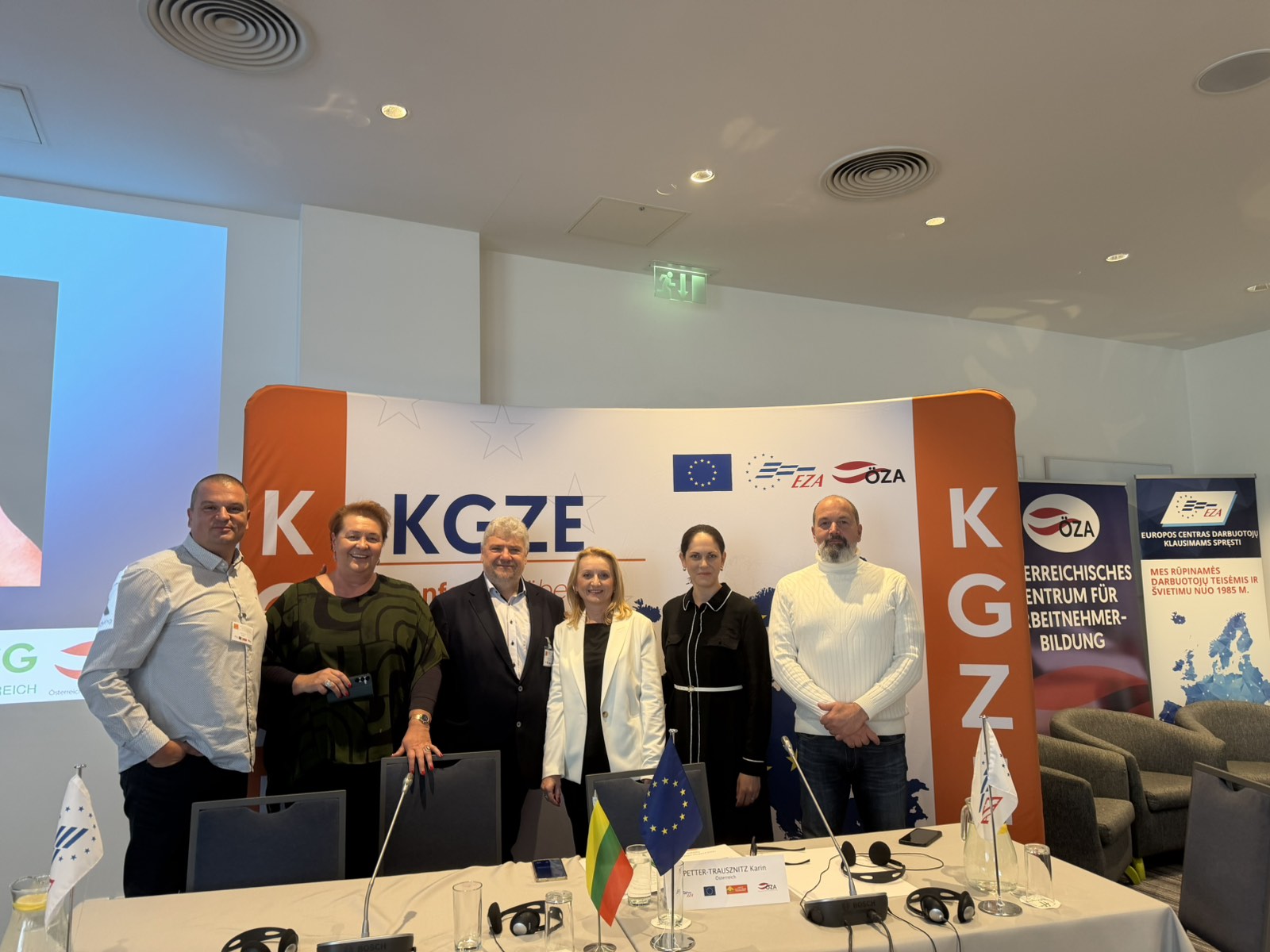
The Austrian Workers' Education Center (ÖZA) in cooperation with the Lithuanian trade union LPS Solidarumas and the European Centre for Workers' Issues (EZA), and with the support of the European Union, organized 37. the 37th Conference on Trade Union Cooperation in Europe (KGZE) from 27 to 29 May 2025 in Vilnius (Lithuania).
The theme of this year's conference was "Conflict or Synergy - People and Artificial Intelligence in the Workplace."
The conference was attended by representatives of trade union organizations from 20 countries: Albania, Belgium, Bosnia and Herzegovina, Bulgaria, Germany, Ireland, Italy, Croatia, Lithuania, Moldova, the Netherlands, North Macedonia, Austria, Portugal, Romania, Serbia, Slovenia, the Czech Republic, Ukraine and Cyprus.
The Republic Trade Union of Workers was represented by Ivana Majdak Topić and Mihaela Kemenović.
Welcome speeches and appropriate words to the participants of the Conference were delivered by: Michael SCHEDIWY-KLUSEK, Secretary General of FCG Austria, ÖZA-Austria; Dr. Norbert SCHNEDL, former President of ÖZA, former Federal President of FCG Austria; and Ms. Jovita PRETZSCH, Deputy President of the LPS Solitarumas Trade Union, member of the EESC - Lithuania.
The first day of the conference was moderated by Michael SCHEDIWY-KLUSEK.
Dr. Norbert SCHNEDL, Treasurer of the EZA, former President of the ÖZA, former Federal President of the FCG Austria, gave a presentation on the topic of artificial intelligence and its impact on all areas of life.
Ms. Jovita PRETZSCH, Vice President of the LPS Solitarumas trade union, EESC member – Lithuania, presented the EESC opinion on the Artificial Intelligence Strategy.
The second day of the Conference was moderated by Ms. Jovita PRETZSCH, Vice President of the LPS Solitarumas Trade Union, EESC Member – Lithuania; Dr. Karin PETTER-TRAUSZNITZ, Social Ethics Expert, Education Officer of the FCG – Austria and Alexander JANSA, Federal Organisational Director of the FCG – Austria.
The Conference was joined by Mr. Dennis RADTKE, MEP, EPP Coordinator in the Committee on Employment and Social Affairs, via video link, who stressed that digital progress must serve the people of Europe.
Ms. Lina GIEDRAITIENE, Head of Digital Initiatives at the Ministry of the Economy and Innovation of the Republic of Lithuania, spoke about Lithuanian policy and a holistic view of artificial intelligence.
Mr. Christian SAGARTZ, Member of Parliament for Burgenland, former Member of the European Parliament – Austria, spoke about Europe’s journey in the age of artificial intelligence, from regulation to reality.
The presentation on the topic "Good or bad times? Welcome to the digital age of global change and turmoil" was held by media artist, musician, cultural manager and director of the Ars Electronica Center in Linz – Austria, Mr. Gerfried STOCKER.
University Prof. Dr. Elias FELTEN, Vice-Chancellor, Professor of Labor and Social Law, University of Paris Lodron Salzburg – Austria, spoke about the digital transformation in Europe and what rules are necessary.
Dr. Gerhard BREMM, Head of the Competence Department of the Center for Representing the Interests of Companies, from the Upper Austrian Chamber of Labor, spoke about the principles of labor law in the stress test of the development of artificial intelligence.
The participants of the Conference visited the Municipality of Vilnius, and Mr. Žygimantas Žvinys, Advisor in the Customer Service Subdivision, organized a digital tour of the Municipality, presenting "Smart City Vilnius - from the inside out - it's all about people."
The third day of the conference was moderated by Michael SCHEDIWY-KLUSEK.
Mr Uwe TERHORST, member of the regional committee of the CDA – Germany, emphasized in his presentation that the focus must be on people, that natural intelligence has priority.
Ms Kristina KRUPAVIČIENĖ, President of LPS "Solidarumas", member of the EESC – Lithuania, spoke about artificial intelligence and the trade union perspective.
The following presented their trade union organizations:
Mr Andreas ANTONIOU, Secretary for Trade Union Development and Action, DEOK – Cyprus, on the topic "Trade union work in Cyprus in light of the EU Council Presidency."
Mr Ondrej Vaclavek, KAP – Czech Republic, on the topic "The situation of workers in the Czech Republic and developments since their accession to the EU."
Based on the presentations and discussions held during the 37th Conference on Trade Union Cooperation in Europe, the following conclusions can be drawn:
- Artificial intelligence is becoming an integral part of the world of work and its further development cannot be stopped, but must be directed to the benefit of workers and society. Digital transformation is already affecting employment processes, work organization and everyday work tasks in almost all sectors.
- Artificial intelligence should serve people and must always be human-centered. Conference participants emphasized that human dignity, workers' rights and social justice must remain at the center of all processes of digital transformation and the application of artificial intelligence.
- Artificial intelligence can increase productivity and efficiency of work, but must not replace human judgment in making important decisions. It is particularly important to ensure human oversight of decisions that affect the hiring, promotion, evaluation and dismissal of workers.
- The application of artificial intelligence in employment procedures carries significant risks of discrimination. The use of algorithms for CV screening and candidate selection must be transparent, objective and subject to regular checks to prevent discrimination and unequal treatment of workers.
- The protection of personal data and workers' privacy is one of the key challenges of the digital age. Employers and institutions must ensure effective data protection mechanisms and clearly define the purpose and scope of use of data collected through digital systems and artificial intelligence.
- The development of artificial intelligence poses new challenges to existing labour legislation. European and national legislation needs to be continuously adapted to protect workers' rights in the face of increasing automation and digital surveillance.
- Trade unions have an important role to play in shaping the rules for the application of artificial intelligence in the workplace. Social dialogue between trade unions, employers and policymakers is essential to ensure fair and responsible use of new technologies.
- The growing pressure on workers due to automation and the potential for job substitution requires additional protection measures. Investments in lifelong learning, retraining and the development of digital competences are needed so that workers can actively participate in the changes brought about by artificial intelligence.
- The European Union should continue to develop a common regulatory framework for artificial intelligence. Clear rules, accountability for decisions made by algorithms and effective oversight mechanisms are key to building citizens' and workers' trust in new technologies.
- Artificial intelligence should not be seen solely as a threat or solely as an opportunity. Its effects will depend on the rules of application, the level of protection of workers' rights, and society's willingness to ensure synergy between technological development and human labor.
The future of work should be built on a partnership between humans and artificial intelligence. Technological innovations can bring significant benefits, but only if their development and application are based on ethical principles, protection of human rights, social dialogue and active involvement of workers and their representatives in decision-making processes.
You can view the photo gallery at: https://rsr.com.hr/gallery
Foto: RSR