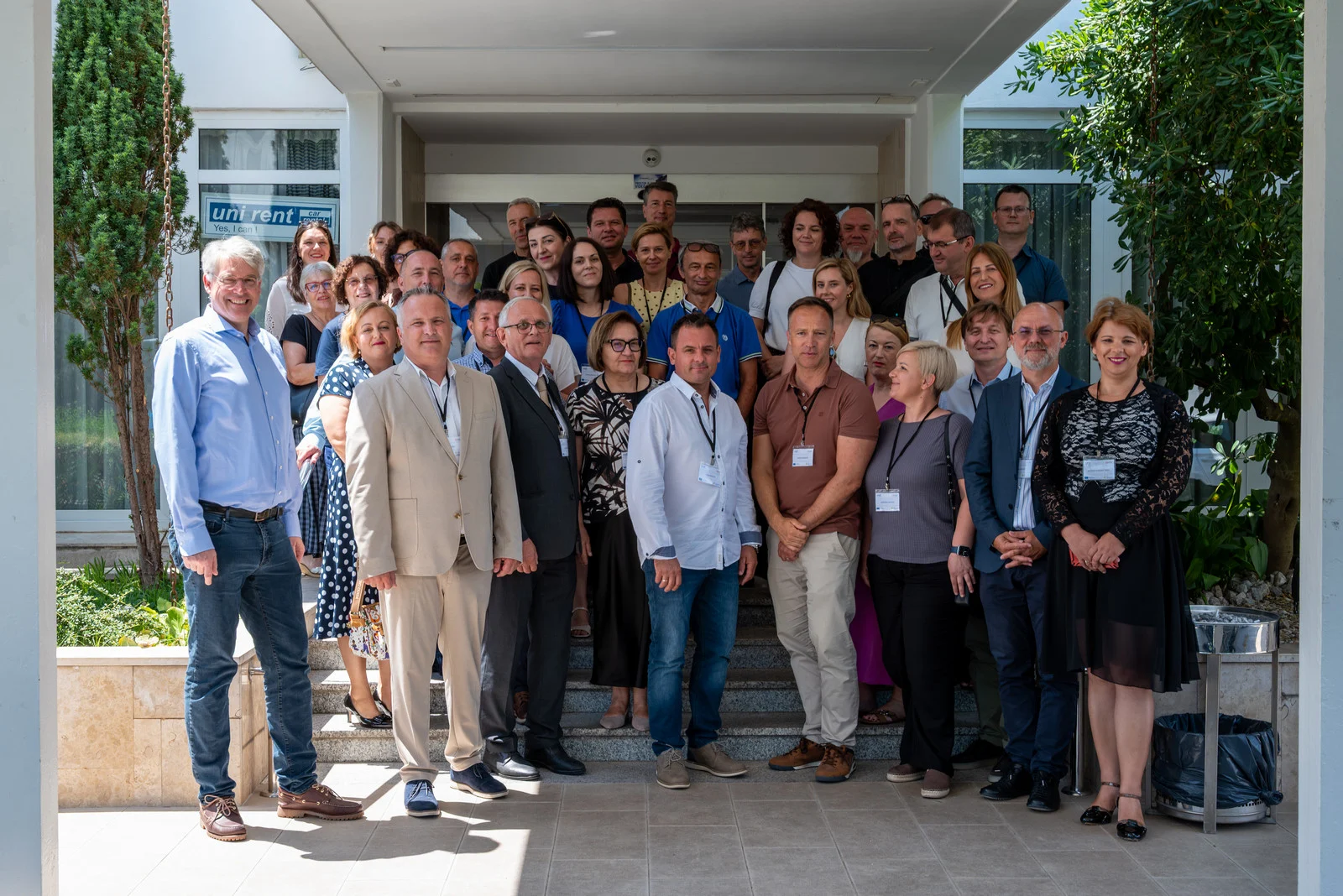
ZADAR, 2 July 2026 – The Croatian Telecommunications Union and the Republican Workers' Union today held the final conference of the ESF+ project "Challenges of Social Dialogue in the Digital Economy: Focus on the Private Sector and ICT" (SD-DEI – Social Dialogue in the Digital Economy and ICT) in Zadar. The conference highlighted the low coverage of workers by collective agreements, the challenges associated with implementing the EU Pay Transparency Directive, and the need to regulate the use of artificial intelligence in the ICT sector.
Professor Dragan Bagić, PhD, of the Faculty of Humanities and Social Sciences, University of Zagreb, pointed out that the ICT sector is facing yet another major transformation, primarily driven by the growing use of artificial intelligence tools.
"Social dialogue will be crucial throughout this process, because there is no single path or strategy for integrating AI tools into business operations. These tools can be introduced in ways that enhance workers' productivity and, consequently, improve companies' performance. However, they can also be implemented with the aim of replacing workers. In the long run, this latter strategy is undoubtedly the less beneficial one for everyone," professor Bagić said.
Speaking about the international dimension of social dialogue and the future of work in Europe, Oliver Roethig, President of UNI Europa, stressed that companies covered by collective agreements—where employees and management regularly sit down together and engage in dialogue—are more successful in the marketplace.
"In such companies, workers enjoy greater job security, better working conditions and decent wages. Moreover, companies operating under strong sectoral collective agreements are more resilient during times of crisis and contribute to a more equitable society," said Roethig, adding that collective bargaining is a test of democracy for every society.
As part of the conference, a panel discussion entitled "The Future of Social Dialogue in the Context of the Digital Transformation of the Labour Market and Artificial Intelligence" was held.
Croatia is among the EU Member States where collective agreement coverage remains below the European benchmark of 80 per cent, making it legally obliged to increase that coverage. For this reason, the National Programme for the Promotion of Collective Bargaining for the period 2026–2030 is currently being introduced.
"Sectoral social dialogue under this programme can most easily begin with issues where employers and workers share common interests, namely the shortage of skilled professionals, upskilling, clear rules governing artificial intelligence, and the right to disconnect. The Government Office for Social Partnership brings trade unions and employers to the same table, provides relevant data, and finances the strengthening of their capacities. We do not impose collective bargaining, but we create the conditions that make it possible," pointed out Marina Kasunić Peris, Head of the Department for the Promotion of Social Dialogue at the Government Office for Social Partnership.
Marija Hanževački, Secretary General of the Independent Croatian Trade Unions, emphasized that in Croatia, representatives of the Croatian Employers' Association and the Government consistently express their support for social dialogue in public and verbally endorse collective bargaining.
"Now that the time has come to support a document that could improve the quality of social dialogue and encourage collective bargaining, the Croatian Employers' Association (HUP) has suddenly slammed on the brakes, looking only for reasons and justifications not to support it. For some reason, the Government also appears willing to back that position. Is this responsible social partnership, or simply the usual avoidance of responsibility on the part of both sides?" Marija Hanževački asked during the panel discussion.
The EU Pay Transparency Directive, which aims to ensure equal pay for women and men, was due to be transposed into Croatia's Labour Act by 7 June 2026. However, this has yet to happen.
"Trade unions have high expectations regarding the implementation of the Pay Transparency Directive, particularly with respect to the mandatory evaluation of jobs, as the relative value of different positions has become distorted over time. I believe that greater transparency in pay-setting rules will contribute to equality and ensure fair application of the principle of equal pay for work of equal value," said Vesna Mamić, President of the Croatian Telecommunications Union.
Collective bargaining is virtually non-existent in digital industries such as ICT, even though an increasing number of decisions on recruitment, performance evaluation and dismissals are being made by algorithms.
"Adapting to digital transformation means investing in people. The benefits of digitalisation for social dialogue include faster and more efficient bargaining processes, as well as greater involvement of workers' representatives in employers' business policies. Ultimately, this leads to more satisfied and productive employees and, consequently, to employers that are more competitive in their respective industries," said Anita Zirdum, Acting Director General of the Directorate for Labour and Occupational Safety at the Ministry of Labour, Pension System, Family and Social Policy.
"Whether workers are aware of it or not, artificial intelligence is increasingly being used to make decisions that directly affect them from recruitment and work scheduling to performance evaluation and even dismissal. This can result in violations of workers' rights and various forms of discrimination. Alongside effective regulation and oversight, it is therefore essential to strengthen social dialogue and raise workers' awareness of artificial intelligence. Conferences such as this one make an important contribution to that goal," said Vatroslav Subotić, Adviser to the Ombudswoman.
Antonija Jukić, Legal Adviser and member of the Collective Bargaining Committee at Hrvatski Telekom, said that she sees the greatest risk of artificial intelligence not in the technology itself, but in its irresponsible use, from inaccurate or biased outcomes to threats to privacy and data security.
"This is why the responsible use of artificial intelligence is an absolute priority at Hrvatski Telekom. We have established the role of AI Compliance Officer and adopted an Artificial Intelligence Governance Policy that sets out clear rules for the ethical, secure and transparent use of AI. In addition, we have launched the national programme 'AI Can Do It for You', through which we provide all citizens with free training on the safe and responsible use of artificial intelligence. Our goal is for AI to serve as a tool that enhances productivity and quality of life, while always being underpinned by knowledge, critical thinking and users' trust," she concluded.
The conference was held as part of the ESF+ co-funded project "Challenges of Social Dialogue in the Digital Economy: Focus on the Private Sector and ICT" (SD-DEI – Social Dialogue in the Digital Economy and ICT), with a total project value of EUR 229,273.29.
Foto:HST

The content of this material is the sole responsibility of the Croatian Telecommunications Union and Republic Workers Union and does not necessarily reflect the official views of the European Union or the European Commission. The European Commission cannot be held responsible for it. The project is co-financed by the European Union through the ESF+ "Efficient Human Resources" programme.