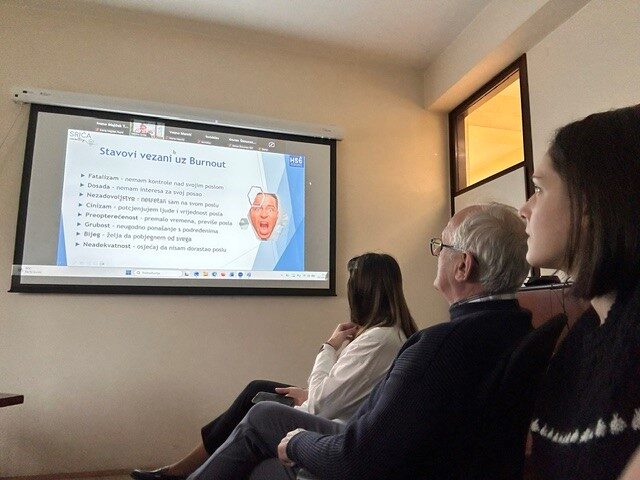
On February 20, 2026. and 20.03.2026. as part of the ESF+ project "Challenges of social dialogue in the digital economy: Focus on the private sector and ICT", two online educations were held by prof. Ph.D. Velimira Sriće on Leadership and AI, and Antistress and mental health.
At the online education on 20.02.2026. prof. dr. sc. Velimir Srića referred to generative artificial intelligence (GenAI) as an advanced type of artificial intelligence that generates new content (text, images, code, music), based on the analysis of existing data. Algorithms such as ChatGPT, DALL-E, GitHub Copilot and DeepSeek create original solutions instead of just analyzing data. GenAI is increasingly being applied in areas such as visual design, programming and scientific research, and it is predicted that by 2027 it will generate 80% of the code in software development.
However, GenAI also brings challenges. While it can increase productivity, it faces problems such as inaccuracy, data bias, energy demands, and the risk of misuse (e.g., creating misinformation or deep-seated lies).
Prof. Dr. Srića also referred to how every technology is a “magic wand” or a “machine for destruction”. Fear of artificial intelligence (AI) often stems from ignorance and insecurity. The main fear is the loss of control, but this can be overcome through education, constant practical use and critical thinking. AI is not a replacement for human abilities, but a tool for increasing them. When properly applied, it can significantly improve our work and everyday life, without compromising human autonomy and creativity.
In the second part of the online lecture, the leadership challenges of the disruptive age were discussed.
Fear of “disruption” in business is increasingly present, as almost 40% of CEOs believe that their companies will not be economically viable in 10 years without transformation. Also, 66.6% of organizations are not ready for the rapid pace of change in their industry. This demonstrates the necessity of strategic foresight in order to successfully adapt to the upcoming changes.
Disruption of classical ideas of leadership is also becoming evident. From the traditional institutional approach, we have moved to personalized leadership, where leaders become the center of power. Also, while classic leaders look for rationality and long-term strategies, disruptive leaders make impulsive decisions driven by emotions.
At the online training on 20.03.2026. prof. dr. sc. Velimir Srića conducted training on anti-stress and mental health, and noted that caring for employees' mental health is becoming a strategic advantage for companies, because it increases job satisfaction, engagement and productivity, and reduces employee turnover. In addition to physical health, companies need to provide support for mental and emotional health. Given the growing challenges such as stress, violence, social isolation and digital overload, it is important to invest in strategies that include education, flexible working conditions, clear roles, a physical environment that encourages relaxation, and continuous monitoring and improvement of mental health. By introducing assistance programs, mindfulness techniques and creating a culture of trust, organizations can improve the well-being of their employees, reducing stress and increasing their engagement and productivity.
These two online trainings used equipment to support trainings that was procured as part of the ESF+ project "Challenges of social dialogue in the digital economy: Focus on the private sector and ICT".